 |
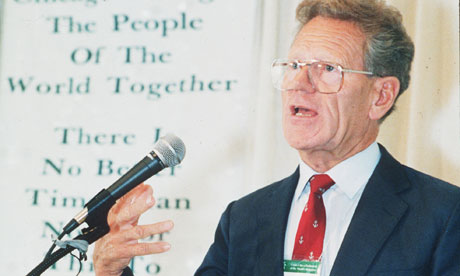
| Hans Küng. Image credit: The Guardian |
I have often observed a specific flavor of theological doublethink among ex-Catholics (and as someone who was raised Protestant, married Catholic, and is currently a practicing atheist, I feel free to point it out): on the one hand, they no longer accept many of the Church's core teachings, and may even routinely attend the services of another religion. On the other, they simultaneously believe that the Church remains the sole source of spiritual and moral truth. These semi-lapsed Catholics thus long for their Church to follow them; they feel their new homes in Episcopalianism, Methodism, or non-observant agnosticism to be a kind of exile.
They will never be satisfied. And here is where communication breaks down between the parties: The Catholic hierarchy happens to believe that its teachings are true. In this case, I -- and they -- don't mean "true" in an abstract moral or metaphorical sense; I mean "true" in a literal and historical sense. They believe that an omniscient being holds the keys to human happiness and wellbeing. It is in a position to do so, because it invented them, and it wove them into the very fabric of the universe when it created it. Furthermore, this being communicated these truths via human means to specific people at specific times in history, that they might understand them and teach others.
Imagine that you believe yourself to be the intellectual descendant of a person who received this message. Obviously, preserving it with perfect fidelity throughout human history, and transmitting it faithfully, is the most important task imaginable! How would you do that? You would want to ensure that not just anyone could teach the message; you would want to limit that to those who had been specially trained over long years by its current custodians. You would instinctually resist even the smallest, most peripheral changes out of fear that the heart of the message would be forgotten. Indeed, even if every other human being alive disagreed with your message, you would still be unmoved to change it in the slightest: after all, whether the message is true and whether it is popular are two utterly unrelated things.
In short, you would behave in exactly the way that the Catholic Church actually does behave.
You will rightly point out at this juncture that the Church has reformed itself many times in response to worldly pressure. For example, it created new monastic orders and reformed its financial practices during the Counter-Reformation, and it adopted local languages and expanded the role of the laity during Vatican II. And throughout this past century it has repeatedly revised its practices concerning the training and administration of priests in order to reduce and address the abuse of children (and many would argue that it must continue to do so). But all of these reforms concern the worldly policies and procedures of the Church; none of them concern its scriptural or moral teachings. I am not aware of any point in time when the Catholic Church began teaching that something it had previously condemned was in fact virtuous or even acceptable.
The distinction between these two categories of teaching underlies a central difference of opinion between fundamentalist believers on the one hand, and I put Catholic authorities in this category, and liberal humanistic believers on the other. The latter tend to relate to their religious institutions as social organs serving the wills and perceived needs of their followers. If this is how you relate to your church, there is very little reason to distinguish between these two categories. But if instead you believe your church to be a divine institution, there is all the difference in the world -- and not only in the world.
So if you are a Catholic, or an ex-, would-be-Catholic, by all means hold your Church to account. Demand behavior worthy of the role it takes for itself. Express yourself honestly and forcefully about those values and beliefs that you do and do not share. But don't hold your breath waiting for it to accept homosexuals, sanction divorce and birth control, or ordain women. The Church is already all in on the far sides of those issues. Whether or not you follow them there is up to you.


No comments:
Post a Comment