Sometimes, people without their own ideas will pretend to have them in order to force those with ideas to address their figments and thereby delay any meaningful action. They create a false controversy by putting forth "alternatives" that exist only in opposition to the ideas of others, and then they complain loudly if a decision process moves on without them, claiming that the issue isn't settled yet.
I've encountered this recently in my professional life, and we see it in politics all the time. We saw it in the run-up to the Iraq war: France and Germany suddenly developed strong opinions about the use of sanctions and of force in Iraq when they had been perfectly happy letting their American and British allies enforce international law and police no-fly zones for them for a decade.
We're seeing it now in the U.S. Congress, where Republicans are opposing health care reform.
Congressional Republicans say the Senate bill was "rushed" through. Bullshit. The votes were held in the early morning -- with a week's public notice, so don't pretend this was snuck by -- because of Republican parliamentary maneuvers. And this process has been going on for a full year. Anyone who doesn't know by now what the issues on the table are hasn't been paying attention.
As a refresher: The process began with the president taking off that table something that the Democratic base dearly loves: single-payer health care. Then he put on the table something that Republicans love: malpractice litigation reform. Republicans ignored these concessions, but that doesn't mean the Left got its way. Today, any government-run system of any stripe is dead in the water and the Senate and House bills both contains vigorous anti-abortion language. Republicans should be happy about these compromises.
Instead, congressional Republicans say the process didn't include their ideas. Bullshit. Yes, it's true that some Republicans put forth some ideas for how to reform our system. Some of these ideas, like giving the same tax break to individuals purchasing insurance that employers get, were good ones. Here's the rub: not many of their fellow Republicans actually backed these bills.
Its not like these people have no access to the media. If there were a comprehensive bill, with the support of the majority of the Republican caucus, and the Democratic leadership refused to take it up, do you think that might make the news? But we haven't heard that story, have we?
Republicans, my friends: You had six years in charge of both the White House and the Congress. For another six year before that, you had the Congress, and the White House was held by a Democrat who was extremely interested in health care reform. You did nothing. Today, someone else is doing the job for you, and suddenly you're full of innovation and righteous indignation. Give me a break.
Thursday, December 24, 2009


Merry Christmas, Cherpumple
in categories:
entertainment,
journal
I can't speak for all of you up there in the snow-ravaged north, but around these parts, all the news is of the cherpumple monster pie cake. Says creator Charles Phoenix, "The Cherpumple is the desert version of the Turducken."
Me, I've never been a big one for cherry pie, and I've always felt that white cake is a waste of everyone's time. Chocopumple, anyone?
Me, I've never been a big one for cherry pie, and I've always felt that white cake is a waste of everyone's time. Chocopumple, anyone?
Sunday, December 20, 2009
Oh Captain, My Captain
in categories:
entertainment
Disney has announced that "Captain Eo" will be returning to Disneyland starting in February. Is it wrong for me to be so excited about that?
Wednesday, December 16, 2009
Who gets a seat at the climate change table?
Representatives of developing countries at the UN climate conference in Copenhagen are upset: they say that developed countries aren't addressing their concerns.
Folks, I appreciate your situation. But let me be cruelly blunt. Why are we having international conversations about this in the first place? Because addressing climate change could be expensive, and no one wants to blink first. No country wants to put in place rules stricter than those of its neighbors out of fear that businesses and their investment will relocate to those neighbors. To the people in small developing countries: you are not competing in this staring contest.
The players are:
So who are these players?
If you want to get people riled up about an issue, holding a UN conference and making a big show about "we're all coming together" is a good way to do it, provided you can back it (which is in no way assured in this case). But make no mistake: any solution will be negotiated among the C11 and might just as well take place in Washington or Brasília as in Copenhagen. Everyone else, though they may suffer greatly from the effects of climate change through no fault of their own, come as beggars to this table.
Folks, I appreciate your situation. But let me be cruelly blunt. Why are we having international conversations about this in the first place? Because addressing climate change could be expensive, and no one wants to blink first. No country wants to put in place rules stricter than those of its neighbors out of fear that businesses and their investment will relocate to those neighbors. To the people in small developing countries: you are not competing in this staring contest.
The players are:
- Countries that emit a lot of greenhouse gases
- Countries rich enough to do something about the gases emitted by (1)
- Countries to which the businesses from (1) might relocate if regulations were tightened
- To the extent that a cap+trade+offsets scheme plays a role in any compromise, countries with a lot of offsets to offer
So who are these players?
- China, the United States, Indonesia, and Brazil.
- The "G7": the United States, Japan, China, Germany, France, the UK, and Italy. (I'm looking at total GDP here; Luxembourg and Qatar may have higher GDP per capita, but they have so few capita that they're not prepared to be a big part of the solution to this problem.)
- The G7, China, and India.
- Indonesia and Brazil. (The link on (1) above applies here too.)
If you want to get people riled up about an issue, holding a UN conference and making a big show about "we're all coming together" is a good way to do it, provided you can back it (which is in no way assured in this case). But make no mistake: any solution will be negotiated among the C11 and might just as well take place in Washington or Brasília as in Copenhagen. Everyone else, though they may suffer greatly from the effects of climate change through no fault of their own, come as beggars to this table.
Sexual Harrassment and How to Avoid It
It's that time of year again (at least at my company): the time when all managers have to go through training on how to avoid and address sexual harassment in the workplace. A friend pointed me to these handy tips, which if universally followed would go a long way towards addressing this problem. This one is my favorite:
8. Always be honest with people! Don’t pretend to be a caring friend in order to gain the trust of someone you want to assault. Consider telling them you plan to assault them. If you don’t communicate your intentions, the other person may take that as a sign that you do not plan to rape them.
Saturday, December 5, 2009
Getting Our Priorities Straight
A good friend just sent me a link to Aaron Swartz's blog. It's really good; I'll be following it.
This post is a response to Aaron's post Keynes, Explained Briefly, an endorsement of the economic theories of John Maynard Keynes. (For some reason, this is my second heavy post on economics in a row. Sorry, folks.)
Here's Aaron's summary of Keynes:
For the sake of argument, let's assume that Keynesian economic theory is the best, most definitive economic theory, beyond dispute.
The economic benefits of applying the model come at a political cost. The problem is that for it to work, you have to give the people who make all the rules, and have the power to enforce them, an additional power: to take your money away. Then you have to trust them to only do so when it's in the long-term interest of you and your community. (If I were a Libertarian, which I'm not, this would be my opportunity to say something glib.)
Such a system may indeed produce great results when it works. But it's not fault tolerant. When you don't have well-meaning, competent, accountable leaders -- when you've given enormous power to the corrupt and/or incompetent and/or unaccountable -- the failure mode is dictatorship and atrocity.
Let's take a historical example. Europeans have generally made a Keynesian economic bargain: give the government great power, and trust good leadership and the parliamentary process to keep that power directed toward Good, not Evil. For the most part, the results have been good: Europe is full of prosperous, developed countries and prosperous, happy people. But every once in a while, a dictator comes to power, shuts down the newspapers, and kills a lot of people.
At this point in my first draft of this post, I tried to count genocides, mass killings, and ethnic cleansings in Europe in the last century. I got a little bogged down: is the Armenian genocide "European"? Sure, there's Bosnia. But do mass killings of Jews, Roma, Yugoslavians, gays, dissidents, etc. in the 30's and 40's constitute multiple incidents or just one? Moscow is in Europe, but the Russians never had a democratic government to begin with; do the Purges count? Let's just sum up by saying: bad people have done a lot of bad things. During the same period, there has been nothing at all similar in North America.
On the other hand, the number of massive global economic slumps caused by the United States in the last 100 years: two. Number caused by anyone across the Pond: none.
So what's your poison?
This post is a response to Aaron's post Keynes, Explained Briefly, an endorsement of the economic theories of John Maynard Keynes. (For some reason, this is my second heavy post on economics in a row. Sorry, folks.)
Here's Aaron's summary of Keynes:
So those are Keynes’ prescriptions for a successful economy: low interest rates, government investment, and redistribution to the poor. And, for a time — from around the 1940s to the 1970s — that’s kind of what we did. The results were magical: the economy grew strongly, inequality fell away, everyone had jobs.We could easily fact-check the above by looking at average economic growth in different decades and evaluating them based on analyses of which policies were more or less "Keynesian." We could do the same for other countries as well. But instead, I'd like to take this idea off on my own tangent. Here's what came to my mind when I read the above paragraphs:
But, starting in the 1970s, the rich staged a counterattack. They didn’t like watching inequality — and their wealth — melt away. There was a resurgence in classical economics, Keynes was declared to have been debunked, and interest rates were raised drastically, throwing millions out of work. The economy tanked, inequality soared, and things have never been the same since. For a while people talked about levels of inequality that hadn’t been seen since the 1920s. Then they talked about a recession the size of which hadn’t been seen since the 1930s.
For the sake of argument, let's assume that Keynesian economic theory is the best, most definitive economic theory, beyond dispute.
The economic benefits of applying the model come at a political cost. The problem is that for it to work, you have to give the people who make all the rules, and have the power to enforce them, an additional power: to take your money away. Then you have to trust them to only do so when it's in the long-term interest of you and your community. (If I were a Libertarian, which I'm not, this would be my opportunity to say something glib.)
Such a system may indeed produce great results when it works. But it's not fault tolerant. When you don't have well-meaning, competent, accountable leaders -- when you've given enormous power to the corrupt and/or incompetent and/or unaccountable -- the failure mode is dictatorship and atrocity.
Let's take a historical example. Europeans have generally made a Keynesian economic bargain: give the government great power, and trust good leadership and the parliamentary process to keep that power directed toward Good, not Evil. For the most part, the results have been good: Europe is full of prosperous, developed countries and prosperous, happy people. But every once in a while, a dictator comes to power, shuts down the newspapers, and kills a lot of people.
At this point in my first draft of this post, I tried to count genocides, mass killings, and ethnic cleansings in Europe in the last century. I got a little bogged down: is the Armenian genocide "European"? Sure, there's Bosnia. But do mass killings of Jews, Roma, Yugoslavians, gays, dissidents, etc. in the 30's and 40's constitute multiple incidents or just one? Moscow is in Europe, but the Russians never had a democratic government to begin with; do the Purges count? Let's just sum up by saying: bad people have done a lot of bad things. During the same period, there has been nothing at all similar in North America.
On the other hand, the number of massive global economic slumps caused by the United States in the last 100 years: two. Number caused by anyone across the Pond: none.
So what's your poison?
Friday, November 27, 2009
Ruminations on Capitalism for Black Friday
in categories:
economy,
masterplan,
values
On this, the greatest feast day in the calendar of buying and selling, I thought I would share a few of my own thoughts on the subject.
Pretty Pictures
People on the Right like to think about economics like this:

But people on the Left prefer to think about it like this:

(The Leftists, of course, being elitist intellectuals, use fancier adjectives than the Rightists.)
I have a different point of view:

The useful thing about capitalism is that it's a really scalable way to govern access to resources. It's all well and good to say "We all own that chair together!" (Socialists, pay attention.) But only one person can actually sit in it at once, so if we all own all chairs together, then we need some kind of Ministry of Chair Sitting to decide who gets to sit in which chairs when. Not only is that a huge bottleneck for all chair-related decisions, but the we-all-own-all-chairs state of the world rapidly becomes indistinguishable from the the-Minister-of-Chair-Sitting-owns-all-chairs state. We're at the Socialism end of the arrow.
It's much more efficient to say "You decide who can sit in that chair, and you decide who can sit in that chair, and you ...." Private ownership scales very efficiently, by which I mean that it is not particularly more difficult to decide who can sit in any particular chair if there are 300 million people and 300 million chairs than if there are only two of each.
Win-Win
This kind of system -- in which individuals are empowered to make resource-allocation decisions -- naturally leads to competition. Everyone wants to make sure he or she has access to a chair whenever he or she wants one. That's not a bad thing; competition focuses the mind, and with so many minds focused on making chairs available, there's a possibility for everyone to benefit.
There's another possibility, though. There's the possibility that some individuals are so much better than their competitors that they eventually acquire almost all of the chairs. (Rightists, now it's your turn to pay attention.) Those of you who were uncomfortable with the the-Minister-of-Chair-Sitting-owns-all-chairs state of the world ought to be equally uncomfortable with the my-rich-neighbor-owns-all-chairs state. Either way, there are no chairs for the rest of us. And people without any hope of a chair of their own are vulnerable to exploitation by those who can offer them the use of a chair from time to time. (Warning: metaphor breaking down!) If the market in chairs is so restricted that they've no hope of winning, those people may stop trying, dragging down the economy with them. They're also more likely to turn to crime to obtain a chair by alternate means. This is the Feudalism end of the arrow. I've drawn it diametrically opposite to the Socialism end, but in some ways the two ends are very similar: a large portion of the resources of the community are in a very few hands, to the detriment not only of the many, but of all.
Capitalism is the state of tension in between the two extremes. It's the competitive game, but played under strict, transparent rules to make sure that winnings are not ill-gotten and that they are not so disproportionate in one round as to make the result of the next round a foregone conclusion. (This is the flow in the overly-glib "equal opportunities vs. equal outcomes" arguments some conservatives make: the outcome of one generation is the opportunity for the next.) There will almost always be one side that seems to be winning at any one time; that's OK. If we keep the rules strict but fair, the other side will get its chance in this tug of war a little later. Remember: when one team in the game of tug-of-war gets all the rope, the game is over. But the capitalist's goal is to keep playing.
Appendix: A Historical Perspective
I recently heard a Libertarian pundit say something like, "If we could just turn the clock back to about 1913, we Libertarians think that would be about right." Folks, there's a reason why Socialism arose during those late years of the Industrial Revolution. It arose in reaction to the economic injustice of the day. A small class of people controlled most of the means of production and most of the good fruits of that production ("robber barons," anyone?). As a result, things often didn't go well between labor and management, you might say.
I see a pattern:
By the late 18th century, the injustices of political feudalism led to populist political uprisings in the American colonies and later in France. In the latter, the Revolution pulled the country far to another extreme and eventually failed. Meanwhile, the more moderate revolution in America (if revolutions are ever "moderate") proved stable and the people who lived under it by and large prospered.
By the early 20th century, massive injustice resulting from a form of economic feudalism led to economic upheaval: the rise of socialism. An extreme form, communism, took hold in many countries but eventually collapsed under its own weight. Meanwhile, capitalist democracies sought to limit the same abuses that had led to the rise of their socialist adversaries: poor working conditions, long hours, indebtedness, and other exploitative practices. Regulations against these practices proved successful, and the people of these countries prospered even while the standard bearers of socialist movements stumbled and fell.
So when you're listening to all of the political name calling, just remember: it's not about capitalism vs. socialism. It's about what kind of decision-making process allows us to move nimbly; it's about more opportunity for more people more often. But that kind of wishy-washy mumbo-jumbo doesn't make for a good sound bite, does it? Folks, capitalism is hard. It's also worth it. Keep up the good work.
Pretty Pictures
People on the Right like to think about economics like this:


I have a different point of view:

It's much more efficient to say "You decide who can sit in that chair, and you decide who can sit in that chair, and you ...." Private ownership scales very efficiently, by which I mean that it is not particularly more difficult to decide who can sit in any particular chair if there are 300 million people and 300 million chairs than if there are only two of each.
Win-Win
This kind of system -- in which individuals are empowered to make resource-allocation decisions -- naturally leads to competition. Everyone wants to make sure he or she has access to a chair whenever he or she wants one. That's not a bad thing; competition focuses the mind, and with so many minds focused on making chairs available, there's a possibility for everyone to benefit.
There's another possibility, though. There's the possibility that some individuals are so much better than their competitors that they eventually acquire almost all of the chairs. (Rightists, now it's your turn to pay attention.) Those of you who were uncomfortable with the the-Minister-of-Chair-Sitting-owns-all-chairs state of the world ought to be equally uncomfortable with the my-rich-neighbor-owns-all-chairs state. Either way, there are no chairs for the rest of us. And people without any hope of a chair of their own are vulnerable to exploitation by those who can offer them the use of a chair from time to time. (Warning: metaphor breaking down!) If the market in chairs is so restricted that they've no hope of winning, those people may stop trying, dragging down the economy with them. They're also more likely to turn to crime to obtain a chair by alternate means. This is the Feudalism end of the arrow. I've drawn it diametrically opposite to the Socialism end, but in some ways the two ends are very similar: a large portion of the resources of the community are in a very few hands, to the detriment not only of the many, but of all.
Capitalism is the state of tension in between the two extremes. It's the competitive game, but played under strict, transparent rules to make sure that winnings are not ill-gotten and that they are not so disproportionate in one round as to make the result of the next round a foregone conclusion. (This is the flow in the overly-glib "equal opportunities vs. equal outcomes" arguments some conservatives make: the outcome of one generation is the opportunity for the next.) There will almost always be one side that seems to be winning at any one time; that's OK. If we keep the rules strict but fair, the other side will get its chance in this tug of war a little later. Remember: when one team in the game of tug-of-war gets all the rope, the game is over. But the capitalist's goal is to keep playing.
Appendix: A Historical Perspective
I recently heard a Libertarian pundit say something like, "If we could just turn the clock back to about 1913, we Libertarians think that would be about right." Folks, there's a reason why Socialism arose during those late years of the Industrial Revolution. It arose in reaction to the economic injustice of the day. A small class of people controlled most of the means of production and most of the good fruits of that production ("robber barons," anyone?). As a result, things often didn't go well between labor and management, you might say.
I see a pattern:
By the late 18th century, the injustices of political feudalism led to populist political uprisings in the American colonies and later in France. In the latter, the Revolution pulled the country far to another extreme and eventually failed. Meanwhile, the more moderate revolution in America (if revolutions are ever "moderate") proved stable and the people who lived under it by and large prospered.
By the early 20th century, massive injustice resulting from a form of economic feudalism led to economic upheaval: the rise of socialism. An extreme form, communism, took hold in many countries but eventually collapsed under its own weight. Meanwhile, capitalist democracies sought to limit the same abuses that had led to the rise of their socialist adversaries: poor working conditions, long hours, indebtedness, and other exploitative practices. Regulations against these practices proved successful, and the people of these countries prospered even while the standard bearers of socialist movements stumbled and fell.
So when you're listening to all of the political name calling, just remember: it's not about capitalism vs. socialism. It's about what kind of decision-making process allows us to move nimbly; it's about more opportunity for more people more often. But that kind of wishy-washy mumbo-jumbo doesn't make for a good sound bite, does it? Folks, capitalism is hard. It's also worth it. Keep up the good work.
Monday, November 23, 2009
Definitions
The serious part of this post:
We all know what an enabler is: someone who supports someone else in self-destructive behavior. I heard a better, broader definition of this word the other day:
The funny part of this post:
I discovered a new word (the word is old; my discovery is new) that will compete with
kephalonomancy (also "cephalonomancy") for the title of Rick's Favorite Word. The new word is:
We all know what an enabler is: someone who supports someone else in self-destructive behavior. I heard a better, broader definition of this word the other day:
enabler n. One who keeps the consequences of an action from someone else, preventing that person from developing.It makes me think about when I might have been unwittingly involved in an enabling relationship, personally or professionally, on either side.
The funny part of this post:
I discovered a new word (the word is old; my discovery is new) that will compete with
kephalonomancy (also "cephalonomancy") for the title of Rick's Favorite Word. The new word is:
agathokakological adj. Composed of both good and evil.
Friday, November 20, 2009
My Other Blog
in categories:
entertainment,
tech
It may interest you to know that I also blog at work. Needless to say, the posts there are all of a technology and/or business nature.
Saturday, October 31, 2009
Where the Wild Things Are
in categories:
entertainment,
journal,
tech
Last week, I saw the new movie Where the Wild Things Are. This is a movie for adults who remember Sendak's book from their childhood; it is not for their children. It's a terrifying, sad, wonderful movie.
At first, it had me thinking of Fight Club -- not because of any particular similarity in story or storytelling between the two films, but because each tells a kind of coming-of-age story about a powerless male in a world without masculine role models. But while Tyler/The Narrator of Fight Club descends into nihilism, Max among his Wild Things seems to achieve a degree of understanding, at least subconsciously, of how he fits into his family.
Update: Terry Gross has a retrospective of some very interesting past interviews with Maurice Sendak. He comes across as a wise and interesting man, and the new film feels very aligned with the vision he describes for the book.
At first, it had me thinking of Fight Club -- not because of any particular similarity in story or storytelling between the two films, but because each tells a kind of coming-of-age story about a powerless male in a world without masculine role models. But while Tyler/The Narrator of Fight Club descends into nihilism, Max among his Wild Things seems to achieve a degree of understanding, at least subconsciously, of how he fits into his family.
Update: Terry Gross has a retrospective of some very interesting past interviews with Maurice Sendak. He comes across as a wise and interesting man, and the new film feels very aligned with the vision he describes for the book.
The Computer for the 21st Century
in categories:
masterplan,
tech
A coworker recently sent around a copy of Mark Weiser's The Computer for the 21st Century. I remember reading it in college, and it was originally published much earlier: 1991. But the vision it presents is still compelling -- and is (disappointingly) still not reality, (much) more than a decade later.
Even for the non-nerds reading this post, I recommend reading Weiser's article (linked above). But if you don't, here's the first couple of paragraphs by way of summary:
Here's what I think is the gap between today's technology and Weiser's vision:
Even for the non-nerds reading this post, I recommend reading Weiser's article (linked above). But if you don't, here's the first couple of paragraphs by way of summary:
The most profound technologies are those that disappear. They weave themselves into the fabric of everyday life until they are indistinguishable from it.Today, we have fast low-power processors, small devices, and powerful networks. But we still spend our days working, browsing the web, and reading email on devices that look and act like computers, which is a problem. Weiser also looked forward to a data-centric world, in which our information is pervasively available but devices are not valuable, not personalized, and not generally noticeable. In contrast, we still very much live in a device-centric world and are transitioning to a network service-centric world. The transition from explicit network services to decentralized pervasive computing is still science fiction, unfortunately.
Consider writing, perhaps the first information technology. The ability to represent spoken language symbolically for long-term storage freed information from the limits of individual memory. Today this technology is ubiquitous in industrialized countries. Not only do books, magazines and newspapers convey written information, but so do street signs, billboards, shop signs and even graffiti. Candy wrappers are covered in writing. The constant background presence of these products of “literacy technology” does not require active attention, but the information to be transmitted is ready for use at a glance. It is difficult to imagine modern life otherwise.
Silicon-based information technology, in contrast, is far from having become part of the environment. More than 50 million personal computers have been sold, and the computer nonetheless remains largely in a world of its own. It is approachable only through complex jargon that has nothing to do with the tasks for which people use computers. The state of the art is perhaps analogous to the period when scribes had to know as much about making ink or baking clay as they did about writing.
Here's what I think is the gap between today's technology and Weiser's vision:
- Pervasive interoperability based on open standards. We still have to think far too much about what format our data is packaged in and what protocol it's traveling in. It's not effortless to connect an arbitrary device to an arbitrary network.
- Pervasive data authorization control. Weiser emphasizes this at the end of his piece: if every device knows where it is, where we are, what we're doing with it -- and is permanently connected to a global network -- we need ironclad privacy controls.
- Truly distributed data storage. Right now, I have two extreme choices: keep my data on a particular device that I own or contract the storage to a service vendor (e.g. Google) that will allow me to access the data from multiple devices. The former gives me control but no flexibility. The latter gives me flexibility but no control: If I lose connectivity, I lose access to my data. If I sever relations with my service provider, I either lose my data or I have to download it all to a particular device -- at which point getting it back into the cloud will be very painful if not impossible.
- Ubiquitous inexpensive hardware. I should be able to walk up to a digital whiteboard in any room and be able to call up my data, or I should be able to grab a computer from the company supply cabinet like I would a pad of paper. The idea that my computer was lost or damaged and therefore a lifetime's worth of data has disappeared is a big problem.
- User interfaces that are as easy on the senses as physical objects. That means electronic paper-like screens and touch input, for example.
Wednesday, October 28, 2009
Saturday, October 10, 2009
Forget Pictures; Give Me a Thousand Words
in categories:
journal
I happened to be listening to a radio program about Google Books this afternoon, and I ended up down a rabbit hole -- a rabbit hole filled with ebooks.
Here's the thing about ebooks: they are inevitable. There is no point in having one set of technologies for transmitting lots of words infrequently, another for fewer words more frequently, a third for audio, a fourth for video, and something else entirely for combinations of words and audio and video. That latter one can do just fine for all the others, thank you, and soon will. Within a few years (or a couple decades), we will drop the "e" from "ebook" as we have dropped the "digital" that used to precede "camera"; all books will be ebooks.
The recent scandal surrounding the Kindle, though, has reminded us of the things that can go wrong when you keep your books where people more powerful than you can get to them. Granted, the Nazis didn't apologize afterwards, they didn't offer anyone their money back, and they ran a government, not a business. (That latter bit makes the 1984 thing more scary, by the way, not less.) But they also had to work a lot hard than did Amazon to get at those books. If all books are ebooks, and the arbiters of reading technology can purge certain titles from that technology by flicking a switch, they can delete every copy of any book (that post-dates that technology) that has ever existed.
Let me not get into whether "that could happen here." Let me instead point out a couple of things:
It's not perfect. The iPhone isn't free of remote exploits (re: the link: yes, that's an "exploit"). I can share books between my iPod and my computer only -- as far as I can tell -- if they originate on the latter. And of course, the iPod doesn't have an electronic paper screen, which hurts readability. But the books are plain text- or EPUB-formatted, which I like, and the iPod is not a dedicated ebook device, which I also like; it makes it harder for The Man to find my books.
If the music industry is any guide, the future will look something like this: someone will finally release a killer device; we will all buy it. Ebooks will become ubiquitous. But lock-in and draconian tactics will piss us off, and we will work hard to circumvent and defeat The aforementioned Man. The Man will eventually give up. I'm optimistic.
Here's the thing about ebooks: they are inevitable. There is no point in having one set of technologies for transmitting lots of words infrequently, another for fewer words more frequently, a third for audio, a fourth for video, and something else entirely for combinations of words and audio and video. That latter one can do just fine for all the others, thank you, and soon will. Within a few years (or a couple decades), we will drop the "e" from "ebook" as we have dropped the "digital" that used to precede "camera"; all books will be ebooks.
The recent scandal surrounding the Kindle, though, has reminded us of the things that can go wrong when you keep your books where people more powerful than you can get to them. Granted, the Nazis didn't apologize afterwards, they didn't offer anyone their money back, and they ran a government, not a business. (That latter bit makes the 1984 thing more scary, by the way, not less.) But they also had to work a lot hard than did Amazon to get at those books. If all books are ebooks, and the arbiters of reading technology can purge certain titles from that technology by flicking a switch, they can delete every copy of any book (that post-dates that technology) that has ever existed.
Let me not get into whether "that could happen here." Let me instead point out a couple of things:
- It already has. We just didn't notice, because not many people have Kindles, and we didn't care, because lots of us have paper copies of 1984. Neither of these things will continue to be the case for long; see above.
- Governments are panicky, corporations are pushovers when it comes to the rights of their customers, and they will work together to shield each other from accountability.
- You think only people who live in countries with sound governments read books? Cast yourself 30 years into the future. (...And pretend that all countries and companies are exactly as they are today. In fact, never mind: just cast yourself into a situation in which all books are digital.) The Chinese government will pick a book it doesn't like and tell Amazon, and Sony, and other companies to delete it from all of the book readers in their country. They will do so.
- Open, DRM-free formats for digital books. No one should be able to decide that we aren't entitled to read our books anymore, and no one should be able to force us to read those books on a certain device. Fortunately, these exist.
- Multiple devices to choose from that support these formats, and the ability to move titles between these devices without help or consent from any central authority. The point is to prevent others from deleting your books remotely, so it's important that these devices can be disconnected from public networks and that they do not provide remote read or write access without authorization. This requirement is harder to meet today.
- The ability to generate a physical, non-digital copy. You can leave paper in a damp cave for two thousand years and still read it. You can't do that with an ebook reader.
It's not perfect. The iPhone isn't free of remote exploits (re: the link: yes, that's an "exploit"). I can share books between my iPod and my computer only -- as far as I can tell -- if they originate on the latter. And of course, the iPod doesn't have an electronic paper screen, which hurts readability. But the books are plain text- or EPUB-formatted, which I like, and the iPod is not a dedicated ebook device, which I also like; it makes it harder for The Man to find my books.
If the music industry is any guide, the future will look something like this: someone will finally release a killer device; we will all buy it. Ebooks will become ubiquitous. But lock-in and draconian tactics will piss us off, and we will work hard to circumvent and defeat The aforementioned Man. The Man will eventually give up. I'm optimistic.
Friday, October 9, 2009
Obama Wins Nobel for Being a Great Guy
in categories:
values
The Nobel Committee announced this morning that American President Barack Obama has won the Nobel Prize in a new category: Being a Great Guy. The new prize will be awarded henceforth to those who show tremendous promise for positive transformative action in the future, but who have not actually accomplished any such things yet.
Seriously, I like President Obama. I voted for him, and I think he's started some positive initiatives that could prove very important if they bear fruit. They haven't done so yet. Awarding such a prestigious prize for "creating a positive atmosphere" is outrageous and undermines the credibility of the prize and of the Nobel Committee. As for nuclear disarmament, there has been aspirational rhetoric and the beginning of a political process, but that hardly warrants the award. Reagan and Gorbachev reduced the size of nuclear arsenals; Obama is so far just talking about it. (Gorbachev previously won the prize himself.)
Furthermore, I find it incredibly inappropriate for the Committee to award such a prize to a sitting world leader. (Though they have done it before.) No national leader is a humanitarian advocate for peace; national leaders advocate for their people, which may require peace or, from time to time, the use of arms. President Obama is the head of the world's largest armed force, a force that is currently effectively occupying two foreign countries. Suppose another 9/11-like event were to occur, and this Nobel Peace laureate were to send troops into Yemen, or North Korea, or Waziristan?
Let's be honest about what this is really about: Europeans love America, and they hated President George W. Bush. That contradiction created cognitive dissonance for them and made them feel bad. (This American relates to the feeling.) The Committee is so happy that they no longer have to compromise their positive feelings for American ideals and opportunities that it has effectively awarded the prize to the American people for electing someone else. Good for us.
Seriously, I like President Obama. I voted for him, and I think he's started some positive initiatives that could prove very important if they bear fruit. They haven't done so yet. Awarding such a prestigious prize for "creating a positive atmosphere" is outrageous and undermines the credibility of the prize and of the Nobel Committee. As for nuclear disarmament, there has been aspirational rhetoric and the beginning of a political process, but that hardly warrants the award. Reagan and Gorbachev reduced the size of nuclear arsenals; Obama is so far just talking about it. (Gorbachev previously won the prize himself.)
Furthermore, I find it incredibly inappropriate for the Committee to award such a prize to a sitting world leader. (Though they have done it before.) No national leader is a humanitarian advocate for peace; national leaders advocate for their people, which may require peace or, from time to time, the use of arms. President Obama is the head of the world's largest armed force, a force that is currently effectively occupying two foreign countries. Suppose another 9/11-like event were to occur, and this Nobel Peace laureate were to send troops into Yemen, or North Korea, or Waziristan?
Let's be honest about what this is really about: Europeans love America, and they hated President George W. Bush. That contradiction created cognitive dissonance for them and made them feel bad. (This American relates to the feeling.) The Committee is so happy that they no longer have to compromise their positive feelings for American ideals and opportunities that it has effectively awarded the prize to the American people for electing someone else. Good for us.
Monday, October 5, 2009
To John, Michael, Eric, Terry, Terry, and especially Graham
in categories:
entertainment,
tech
Good work, gentlemen. Very good work indeed.
Thursday, September 24, 2009
Mutexes and Semaphores
in categories:
tech
Cross-posting from my RTI blog:
This post doesn’t contain any new information or clever opinions. It simply points out a few articles published elsewhere that this humble author suspects his readers will find relevant. (Members of the Embedded group on LinkedIn may have seen some of these articles already, but they have relevance to any multi-threaded system, embedded or not.)
Many developers suffer from confusion with respect to the differences between mutexes and semaphores. Michael Barr of Netrino provides solid information in his article Mutexes and Semaphores Demystified. My summary: mutexes protect shared resources by enforcing mutual exclusion; semaphores should be used for signaling across tasks.
Wednesday, September 9, 2009
Verdict on "The Public Option": Revision
I wrote earlier about my feelings about a so-called "public option" health insurance plan. What I predicted at that time was that a public plan would subsume existing federally financed health plans (Medicare, Medicaid, the VA health plan, government employee insurance, etc.) and as a result would become very much larger than its private competitors. The result, I believed (and still believe), would be the ultimate collapse of those competitors and therefore a hobbling of our health system:
But our president laid out a very different vision of a public option today. The public plan he described violated my first assumptions: it would not automatically subsume the plans offered to government employees, it would not be available to everyone, and apparently even the uninsured would not be enrolled automatically; they would choose among plans like the rest of us. In that case, I have no objection to it. As the president pointed out, public universities coexist with private, and others have pointed out that the government-chartered Postal Service coexists with fully private parcel carriers.
... Although I have to wonder: if the plan is deliberately crippled to keep people out of it, what's the point? Is this political cover for diehards who swore they wouldn't vote for a bill without a public option plus a wink to conservatives that the "option" will be a token only?
- The facade of an employer-based, competitive system would provide less access than a true single-payer system
- ...without permitting the emergence and flourishing of a secondary value-added market, such as exists in the UK and elsewhere
- ...and without any of the benefits that might come from a transparent, competitive, open market.
But our president laid out a very different vision of a public option today. The public plan he described violated my first assumptions: it would not automatically subsume the plans offered to government employees, it would not be available to everyone, and apparently even the uninsured would not be enrolled automatically; they would choose among plans like the rest of us. In that case, I have no objection to it. As the president pointed out, public universities coexist with private, and others have pointed out that the government-chartered Postal Service coexists with fully private parcel carriers.
... Although I have to wonder: if the plan is deliberately crippled to keep people out of it, what's the point? Is this political cover for diehards who swore they wouldn't vote for a bill without a public option plus a wink to conservatives that the "option" will be a token only?
Tuesday, September 8, 2009
Judicial Activism
in categories:
values
Tomorrow, the U.S. Supreme Court will re-hear a case it heard back in March, Citizens United v. Federal Election Commission. Intelligent, principled people can disagree on the particulars of the case; this post isn't about those particulars. It's about the judicial process.
Re-hearing a recent case is very unusual, and it often indicates that the court is strongly considering overturning a previous precedent.
Conservatives are famous for preaching about the dangers of "judicial activism" -- overstepping the role of a jurist and attempting to create new law -- and often criticize liberals for supposedly practicing it. Yet if the supposedly-conservative court rules in favor of Citizens United in this case, it will reverse a century of precedent and overturn federal law.
This is not unlike the recent case DC v. Heller, in which the court overturned both law and long-standing precedent to change the gun laws in the District of Columbia.
I might also ask those conservatives to stand up who disagree with the ruling in Brown v. Board of Education, which overturned decades of precedent in school segregation and the laws of many states.
All of this gives the lie to the "judicial activism" soapbox speeches. I'm not saying that there's no line between the role of a jurist and that of a legislator. But it's a fat grey line, not a thin red one. Everyone has his or her own idea about what the Constitution ought to say. Ninety percent of the time, when someone says "She's a judicial activist," what he really means is, "She disagreed with me." And of course, if the justice does agree with us, we praise her discernment in seeing through to the true, authentic meaning of the beloved text.
So let's just admit it, and let's have a conversation about where that line is and where it should be. But enough soapbox.
Re-hearing a recent case is very unusual, and it often indicates that the court is strongly considering overturning a previous precedent.
Conservatives are famous for preaching about the dangers of "judicial activism" -- overstepping the role of a jurist and attempting to create new law -- and often criticize liberals for supposedly practicing it. Yet if the supposedly-conservative court rules in favor of Citizens United in this case, it will reverse a century of precedent and overturn federal law.
This is not unlike the recent case DC v. Heller, in which the court overturned both law and long-standing precedent to change the gun laws in the District of Columbia.
I might also ask those conservatives to stand up who disagree with the ruling in Brown v. Board of Education, which overturned decades of precedent in school segregation and the laws of many states.
All of this gives the lie to the "judicial activism" soapbox speeches. I'm not saying that there's no line between the role of a jurist and that of a legislator. But it's a fat grey line, not a thin red one. Everyone has his or her own idea about what the Constitution ought to say. Ninety percent of the time, when someone says "She's a judicial activist," what he really means is, "She disagreed with me." And of course, if the justice does agree with us, we praise her discernment in seeing through to the true, authentic meaning of the beloved text.
So let's just admit it, and let's have a conversation about where that line is and where it should be. But enough soapbox.
Socialist Madman Corrupts Children with Message of Personal Responsibility
in categories:
values
September 8, 2009 5:00 pm.
As expected, megalomaniacal anti-American Communist agitator Barack Hussein Obama made yet another attempt to brainwash our country's children today with a subversive message: work hard and stay in school. "We need every single one of you to develop your talents, skills and intellect," said Obama, clearly indicating his desire for his would-be underage proletarian sycophants to rise up -- against the nation's capitalist leaders, its churches, and ultimately each towheaded child's own two-parent nuclear family -- in murderous revolution.
"If you want a good job you have to have a good education," responded one new disciple as his values system slipped away.
With his address, Obama joins discredited Socialists Ronald Reagan and George H. W. Bush, whose attempts to undermine American democracy were crushed in previous decades beneath waves of populist rage.
As expected, megalomaniacal anti-American Communist agitator Barack Hussein Obama made yet another attempt to brainwash our country's children today with a subversive message: work hard and stay in school. "We need every single one of you to develop your talents, skills and intellect," said Obama, clearly indicating his desire for his would-be underage proletarian sycophants to rise up -- against the nation's capitalist leaders, its churches, and ultimately each towheaded child's own two-parent nuclear family -- in murderous revolution.
"If you want a good job you have to have a good education," responded one new disciple as his values system slipped away.
With his address, Obama joins discredited Socialists Ronald Reagan and George H. W. Bush, whose attempts to undermine American democracy were crushed in previous decades beneath waves of populist rage.
Sunday, September 6, 2009
Source Code Hosting for Those of All Sexual Orientations
I was catching up on back issues of the web comic xkcd the other day and I had to chuckle at this one:
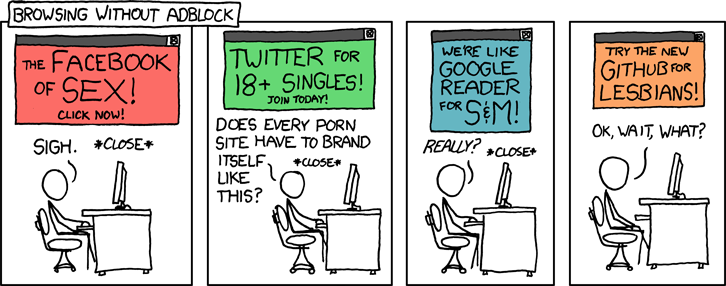
This evening, I decided -- totally independently -- to get a bit smarter about git, and on a whim I googled "GitHub for Lesbians." Lo and behold, I came upon this project immediately: http://github.com/lesbians. It took those lesbians a full three days from the posting of the strip to create the project, but still: I salute you, industrious lesbians.
(For those readers who don't know xkcd: there is a very nearly bijective mapping between between being in the target audience for this comic and thinking it is completely hilarious. Sorry, English majors: it may not be your bag. But no hard feelings.)Maybe not funny enough to click "share" in Google Reader, but definitely cute.
This evening, I decided -- totally independently -- to get a bit smarter about git, and on a whim I googled "GitHub for Lesbians." Lo and behold, I came upon this project immediately: http://github.com/lesbians. It took those lesbians a full three days from the posting of the strip to create the project, but still: I salute you, industrious lesbians.

Saturday, September 5, 2009
My Prairie Home Nemesis
in categories:
entertainment,
journal
Many of those who know me well know that I listen to a lot of public radio. As in, hours. Every day. I find television impossible when I want to multitask, commercial music radio so unpredictable and polluted by commercials as to be utterly not-worth-it, and commercial talk radio so filled with obnoxious glib people with stupid nicknames as to inspire me to criminal acts of violence against them. So the vicious (or virtuous?) cycle continues: the more frustrated I become with other media, the more I turn to my old standby, and the more I do that, ....
It is therefore in this context that I feel the need to get something off my chest:
I have almost no interest, whatsoever, in A Prairie Home Companion.
I have nothing against the man, but honestly: if Garrison Keillor were to be hit by a bus tomorrow, I'm confident that I would traverse the Stages of Grief within about a minute and a half.
Apparently, I am alone in this feeling. I say this because I swear that 80% of all weekend afternoon and evening airtime is dedicated to That Show. I switched on the radio last weekend three different times looking for something, anything, informative and/or interesting and/or humorous to listen to. I got the same episode of "Prairie Home" three times. I just hit the show for the second time today. It's like I'm in a horror movie, running and running, but every time I turn around, Guy Noir a singing cowboy a slice of rhubarb pie the slow-moving guy with the meat hook is right there behind me. Where am I to turn?
It's not just my station either. The last city I lived in, same thing. In fact, try this: go to google.com and type "prai" -- it auto-completes to "prairie home companion" already! How can it be that in all the web there is nothing beginning with those letters that is more popular than this show? Is there no widely esteemed praise band out there? Are there no fans of the prairie dog to be found? I have just learned that there is an entire people out there called the Prai; apparently, nothing that any of them has ever done can rival the cultural juggernaut that is A Prairie Home Companion.
It is therefore in this context that I feel the need to get something off my chest:
I have almost no interest, whatsoever, in A Prairie Home Companion.
I have nothing against the man, but honestly: if Garrison Keillor were to be hit by a bus tomorrow, I'm confident that I would traverse the Stages of Grief within about a minute and a half.
Apparently, I am alone in this feeling. I say this because I swear that 80% of all weekend afternoon and evening airtime is dedicated to That Show. I switched on the radio last weekend three different times looking for something, anything, informative and/or interesting and/or humorous to listen to. I got the same episode of "Prairie Home" three times. I just hit the show for the second time today. It's like I'm in a horror movie, running and running, but every time I turn around, Guy Noir a singing cowboy a slice of rhubarb pie the slow-moving guy with the meat hook is right there behind me. Where am I to turn?
It's not just my station either. The last city I lived in, same thing. In fact, try this: go to google.com and type "prai" -- it auto-completes to "prairie home companion" already! How can it be that in all the web there is nothing beginning with those letters that is more popular than this show? Is there no widely esteemed praise band out there? Are there no fans of the prairie dog to be found? I have just learned that there is an entire people out there called the Prai; apparently, nothing that any of them has ever done can rival the cultural juggernaut that is A Prairie Home Companion.
Tuesday, September 1, 2009
In Progress at OMG: Extensible and Dynamic Types
in categories:
tech
Cross-posting from my RTI blog:
One of the really powerful things about DDS is that it brings to distributed systems the same kind of type safety that you’ll find in local applications. In addition to reducing errors, this deep knowledge of data types can improve performance and resource usage by reducing the number of data copies in the system and easing integration with other field- and type-aware technologies, including relational databases and even Microsoft Excel.Read the whole post here.
Monday, August 31, 2009
On Fire: Update
in categories:
journal
The size of the Station Fire:
c. Saturday morning: 7,500 acres
c. Saturday evening: 20,000 acres
c. Sunday morning: 35,000 acres
c. Sunday evening: 42,000 acres
c. Monday morning [as per KPCC radio; web site not yet updated]: 85,000 acres
Sunday, August 30, 2009
On Fire
in categories:
journal

I took this photograph from the street just outside my front door. The Station File is burning in the Angeles National Forest, which blankets the mountains overlooking northeastern Los Angeles County. It started on Wednesday and now burns across more than 35,000 acres.
The men and women of the fire service battle it tirelessly but have so far been able to accomplish little. Their air tankers circle like moths above the incandescent hillside. I know that, up close, they are impressive craft. But from my present distance, they appear no more consequential before the enormous ridges of orange-gold flame visible through the smoke than those moths would be, and still less consequential before that smoke, which looms like a second mountain above the mountain, high into the grey-blue sky.
As to how the fire started, the question scarcely needs to be asked. The drought continues, and the heat wave, going on a week, seems to increase day by day. I slept on a towel last night and woke up after a fitful sleep to find myself braised in my own juices, for the towel was soaked through and the room was as stifling, though the windows were open, as it had been the evening before.
Meanwhile, the fans, which run day and night, fill the indoors with the smells of ash, of campfires, and of danger.
The air conditioner does not work. Like many things in our otherwise-beautiful home, the arrangement of its parts leaves something to be desired: the ducts bearing cool air run hard by pipes bearing hot water. The latter cause the former to sweat nearly as profusely as we do, and the moisture runs down the drywall, and through it, causing it to sag and buckle, as we do, in the relentless, unquenchable heat.

Update [1:00 PM]: The air conditioner has been repaired, and for the first time in many days, the air is blessedly cool, at least inside. The problem was not condensation after all, but several blockages in both the primary and secondary drainage systems.
By the way, I took the second photo above, not outside my front door, but at the Glendale Galleria. The mall is air-conditioned, you see, and so the whole of unconditioned East LA descended upon it yesterday seeking refuge -- with a predictable impact on our wallets.
Thursday, August 27, 2009
Talk Sense Now, Joe
Joe Lieberman, you've been talking a lot of nonsense about how we ought to reform our health care system, but how we can't afford to do so this year. I shall tell you what I told the good folks at KPCC:
The reformed system you set in place will stand for many decades. During that time, there will be economic upturns and downturns. Rest assured, that whether you pass something this year, when we are poor, or in a year or two, when we are rich again, we will one day be paying for your choice in times such as these. I count seven recessions since the passage of Medicare.
Where we happen to be in the current economic cycle this year or next year is completely irrelevant. And you've been around the block enough times to have figured that out for yourself.
Yours, very sincerely.
Tuesday, August 25, 2009
Verdict: Follow-Up
This post is a follow-up to my previous post, "Verdict on 'The Public Option': Against." Specifically, it's a follow-up to Adam's excellent and in-depth comment on that post. I started to reply in my own comment, but that became even longer than the original comment, which seemed a bit excessive, so rather than showing some self discipline and cutting the sucker down, I decided to make it into a whole new post. So go read that first post, then read Adam's comment, and only then continue reading below. Otherwise, it may not make a whole lot of sense -- and you'll have no one to blame but yourself.
I think that maybe the term "market" is getting in the way. Let me come at it from a little different angle: I think Jane is a grownup who should be able to make her own decisions about how to prioritize her own spending. It's not my business to "let" her spend or save more or less of her own money -- provided she's not asking me to foot the bill (see my earlier post on "Things That Are True About American Health Care"). A dual mandate -- everyone must have insurance, every insurance company must take every comer at a "reasonable" (TBD) rate -- takes care of that.
So if we've established that Jane has insurance to cover at least her catastrophic needs, the next question is: how should she pay for it?
1. She could pay a flat rate for an all-inclusive, comprehensive plan that covers everything with no deductible and no co-pays. There are lots of things in life that people pay for in this way, including some health plans. But I get my home phone service this way too. My parents like to take vacations this way. Generally, when things are "all-inclusive", customers tend to use a lot more of them, and vendors tend to pad the prices in exchange for the convenience and to make sure they don't lose out.
2. She could pay a mostly-all-inclusive rate with some kind of minimal out-of-pocket expense to discourage frivolous use. Lots of insurance plans work this way, with minimal deductibles and/or $5-20 co-pays. I talked to one doctor who told me that this kind of plan makes a big difference over the previous option: with even a $10 co-pay to consider, a mom with 3 kids will make appointments for each them when necessary; with no co-pay, any time one of them goes in, she'll ask for all of them all to be seen, as long as she's there anyway. It might not make her kids any healthier, but the cost is no skin off her nose, so why shouldn't she use the system that way? It's the tragedy of the commons.
3. She could pay almost everything out of pocket and use her insurance only for catastrophic costs. This will encourage even more discretion on her part -- but perhaps equally important, philosophically speaking, it will enable/encourage her to act as an empowered, independent adult.
As for fire insurance or the fire department: it's an interesting analogy, but I don't think it holds. Neither pays for smoke detectors or their batteries. They don't pay for improved wiring for my home, or better insulation, or any other maintenance measure that might hypothetically reduce the risk of fire in the future. A fire or homeowner's policy (sold to me by a private company, and paid for with my after-tax dollars) only pays out if there's an actual fire; the rest I pay out of pocket at my discretion. I decide how much homeowner's/fire insurance I want, at what rate, what deductible I'm comfortable with, and so on.
You could make the argument that I would be better off if someone forced me to hire an electrician to inspect my wiring once a year or to buy a more comprehensive fire insurance policy with a lower deductible. But those choices have associated costs, and I'm not sure who's better able to decide which costs make sense for me than me. A case in point: just a couple of weeks ago, I went in to see my dentist. He gave me several recommendations; some of those were covered by my insurance and some weren't, and I chose to take his advice in some cases and to wait and see in others. I made a financial trade-off with respect to my health care, just like I do in every other part of my life.
My opinion: it's only just to mandate that I bear a certain cost if by not bearing that cost, I pass it on to other people. To beat the dead fire department horse a bit more, I'm required to have a certain gauge wiring in my home, and I'll probably get a break on my insurance premiums if I have a smoke detector and/or sprinkler system. I'm happy to apply the same standard to health care and mandate that everyone have a certain minimum level of insurance to cover emergency and/or catastrophic care. It might be a reasonable cost-saving measure to enhance that mandate with minimal-but-regular publicly funded checkups. But beyond that, I start to get a bit uncomfortable. Not panicked! Not worked up into a lather about the supposed evils of The "S" Word. But ... uncomfortable.
I think that maybe the term "market" is getting in the way. Let me come at it from a little different angle: I think Jane is a grownup who should be able to make her own decisions about how to prioritize her own spending. It's not my business to "let" her spend or save more or less of her own money -- provided she's not asking me to foot the bill (see my earlier post on "Things That Are True About American Health Care"). A dual mandate -- everyone must have insurance, every insurance company must take every comer at a "reasonable" (TBD) rate -- takes care of that.
So if we've established that Jane has insurance to cover at least her catastrophic needs, the next question is: how should she pay for it?
1. She could pay a flat rate for an all-inclusive, comprehensive plan that covers everything with no deductible and no co-pays. There are lots of things in life that people pay for in this way, including some health plans. But I get my home phone service this way too. My parents like to take vacations this way. Generally, when things are "all-inclusive", customers tend to use a lot more of them, and vendors tend to pad the prices in exchange for the convenience and to make sure they don't lose out.
2. She could pay a mostly-all-inclusive rate with some kind of minimal out-of-pocket expense to discourage frivolous use. Lots of insurance plans work this way, with minimal deductibles and/or $5-20 co-pays. I talked to one doctor who told me that this kind of plan makes a big difference over the previous option: with even a $10 co-pay to consider, a mom with 3 kids will make appointments for each them when necessary; with no co-pay, any time one of them goes in, she'll ask for all of them all to be seen, as long as she's there anyway. It might not make her kids any healthier, but the cost is no skin off her nose, so why shouldn't she use the system that way? It's the tragedy of the commons.
3. She could pay almost everything out of pocket and use her insurance only for catastrophic costs. This will encourage even more discretion on her part -- but perhaps equally important, philosophically speaking, it will enable/encourage her to act as an empowered, independent adult.
A health savings account helps Jane increase the threshold of "almost everything." It's like a 401(k) for health care: you choose some amount of your income to defer into it, then when you need care, you pay for it from the account. (401(k) dollars can be borrowed for other purposes; I'm not sure whether health savings accounts typically work the same way, but they should.) It's like the "cafeteria"/flexible spending account many companies offer, but you don't have to guess how much money you'll spend ahead of time and the funds roll over indefinitely. The tax incentive plus automatic deductions from your paycheck make it easy to do the right thing by saving.
Then the account is paired with a high-deductible (a couple grand) standard health insurance plan to cover you if you don't have enough in the savings account or choose not to use it. Just like with a 401(k), many employers will deposit some additional funds in your account up to some level, which ensures that you'll nearly always have a certain minimum balance in the account. I have a family member with a plan like this -- her employer contributes enough to the plan to meet the deduction every year, so in terms of net funds out of pocket, it's no different than an all-inclusive plan -- except that if she saves money, she gets to keep those savings in your own account.
What's not to love? I'd take a plan like that if my employer offered it.
For all of the people telling me that we don't buy health care like we buy widgets (not just you, Adam :-]), a lot of times, we do. With the exception of negligent young men like us, most insured people get annual checkups. Many, if not most, people get semi-annual dental checkups. A large percentage of women use birth control that they have to buy again every month or every few months. Any time a couple has a baby, they have 9 months warning. These expenses are relatively low and very predictable, and insurance companies are clever enough to price them into the plans they offer and to make sure that they get their cut -- even if they're not-for-profit and that cut is just administrative overhead.
Then the account is paired with a high-deductible (a couple grand) standard health insurance plan to cover you if you don't have enough in the savings account or choose not to use it. Just like with a 401(k), many employers will deposit some additional funds in your account up to some level, which ensures that you'll nearly always have a certain minimum balance in the account. I have a family member with a plan like this -- her employer contributes enough to the plan to meet the deduction every year, so in terms of net funds out of pocket, it's no different than an all-inclusive plan -- except that if she saves money, she gets to keep those savings in your own account.
What's not to love? I'd take a plan like that if my employer offered it.
For all of the people telling me that we don't buy health care like we buy widgets (not just you, Adam :-]), a lot of times, we do. With the exception of negligent young men like us, most insured people get annual checkups. Many, if not most, people get semi-annual dental checkups. A large percentage of women use birth control that they have to buy again every month or every few months. Any time a couple has a baby, they have 9 months warning. These expenses are relatively low and very predictable, and insurance companies are clever enough to price them into the plans they offer and to make sure that they get their cut -- even if they're not-for-profit and that cut is just administrative overhead.
As for fire insurance or the fire department: it's an interesting analogy, but I don't think it holds. Neither pays for smoke detectors or their batteries. They don't pay for improved wiring for my home, or better insulation, or any other maintenance measure that might hypothetically reduce the risk of fire in the future. A fire or homeowner's policy (sold to me by a private company, and paid for with my after-tax dollars) only pays out if there's an actual fire; the rest I pay out of pocket at my discretion. I decide how much homeowner's/fire insurance I want, at what rate, what deductible I'm comfortable with, and so on.
You could make the argument that I would be better off if someone forced me to hire an electrician to inspect my wiring once a year or to buy a more comprehensive fire insurance policy with a lower deductible. But those choices have associated costs, and I'm not sure who's better able to decide which costs make sense for me than me. A case in point: just a couple of weeks ago, I went in to see my dentist. He gave me several recommendations; some of those were covered by my insurance and some weren't, and I chose to take his advice in some cases and to wait and see in others. I made a financial trade-off with respect to my health care, just like I do in every other part of my life.
My opinion: it's only just to mandate that I bear a certain cost if by not bearing that cost, I pass it on to other people. To beat the dead fire department horse a bit more, I'm required to have a certain gauge wiring in my home, and I'll probably get a break on my insurance premiums if I have a smoke detector and/or sprinkler system. I'm happy to apply the same standard to health care and mandate that everyone have a certain minimum level of insurance to cover emergency and/or catastrophic care. It might be a reasonable cost-saving measure to enhance that mandate with minimal-but-regular publicly funded checkups. But beyond that, I start to get a bit uncomfortable. Not panicked! Not worked up into a lather about the supposed evils of The "S" Word. But ... uncomfortable.
Promising Political Upheaval in Iraq
in categories:
values
There's a new political coalition in Iraq, and it doesn't include the current prime minister. That's an unhoped-for blessing on top of the coalition's two other notable characteristics: it's a secular group including both Sunnis and Shia, and it includes a number of parties that previously joined al-Maliki's Dawa party in the Iranian-backed United Iraqi Alliance.
I say that al-Maliki's absence is an unhoped-for blessing not because I have anything against the man, but because it seems to me to provide evidence for the development of a real political culture in Iraq. After long years of infighting, majority and minority parties are learning to work together to use the political process to their benefit. It's too early by far, of course, but I might even go so far as to hope that the next election transfers power to a new party and a new prime minister. Because there as here, it's the political process that's most important, not the outcome of any one contest.
Some Non with Your Fiction?
in categories:
entertainment
I saw the new movie "District 9" recently. It was a good film, and I thought the use of extraterrestrials as a socially disadvantaged class was an interesting way to bring social commentary into an action picture. (Although more accurately, the movie is really a socially conscious drama that happens to feature a lot of action and ultraviolence.)
What I didn't realize until today is that the "alien" ghetto in the film isn't just a metaphor for the South African township of Soweto; it was actually filmed there. The shacks in which the aliens live are not sets; they're the homes of human beings who live in Soweto today. The movie that I thought was a historical commentary on apartheid turns out to be a very modern criticism of its legacy. It's a very sobering thought, but it makes me appreciate "District 9" even more.
Wednesday, August 19, 2009
Verdict on "The Public Option": Against
With all the conviction on each side of the question "should a universally available government-run health care payer compete with private payers," I had a hard time, for a long time, gleaning any actual evidence for either position. But after some reading, a good deal of listening, and even more thinking, I've concluded that the answer is No. I believe that such a system would be a half measure less desirable than the full-throated alternative on either side of it.
Adding Up the Numbers
Opponents of the public option often make vague conspiratorial statements like "We can't expect the government to play fair in any competition." But you don't have to imagine any such thing to conclude that "competition" will be pretty one-sided. Let's look at the numbers:
A lot of people's health care is paid for by the government today (60%, by one JAMA estimate -- quoted here and here):
- The elderly, who are eligible for Medicare (about 15% of the population)
- The poor, who are eligible for Medicaid (about 20%)
- Government employees, who receive health benefits from their employers (about 8%)
- Veterans, who are eligible for benefits through the VA (about 10%)
- Public school teachers (about 1%)
- ...and so on.
By my reckoning, we've got over 50% of the population in the public plan semi-automatically -- we're not even counting any person or company that might "choose" the plan yet.
- Consider the "brand" power of any public plan. Everyone will know that the plan exists and that they are eligible for it. Everyone will know something about what the plan covers, because everyone will know people enrolled in the plan. This ubiquity will encourage further enrollment.
- Under measures in both Houses, families could be eligible for subsidized premium payments even up to income levels four times the poverty level -- almost $90,000. Will these subsidies be available for premiums paid to private plans as well?
- As a federally chartered organization, will the Federal insurer be able to operate nationally under a single set of rules? If so, that would represent a significant cost advantage over private insurers, who are regulated separately in each state.
We're talking about Walmart-level inequities of scale and more -- except that "Walmart" will be run by the government. (Tangent: I wonder what the correlation is between generalized rage against Walmart and generalized enthusiasm for publicly funded health care....) Mom & Pop, Inc. cannot compete on price with Walmart, regardless of how efficiently Mom and Pop run their business and regardless of whether they hope to turn a profit. They are outclassed, and so will be private health insurers.
If You Can't Beat 'Em...
When a business cannot compete on price, it typically moves up the value chain: it charges a premium price, so it must have a premium offering. But premium insurance plans are precisely those that are likely to be taxed in order to pay for the subsidies that will be required for the less-well-off. Closed, too, could be the secondary insurance market: In the UK, where everyone receives their primary insurance from the National Health Service, rather than through their employers, many employers offer secondary insurance as an employment benefit. But with primary insurance in the US still tied to employment, a sizable secondary insurance market is unlikely to develop: how many employers are likely to offer you two health insurance policies simultaneously as a standard benefit?
My conclusion: "competition" between public and private health care insurance plans is a fantasy, whether its backers acknowledge/hope/plot it or not. A public "option" will become a de facto single payer system -- but by maintaining the fiction that it is one of many competitors and is tied to employment, it will be unable to deliver all of the benefits of a true single-player plan. If we're to have a single-payer, a government-only-payer, health care system, we'd better start having that public debate. Let's stop pretending that we're talking about "If you like what you have, you can keep it, but there's this other option...."
Cost vs. Access
There are two goals of any health care payment reform: controlling costs and broadening access. These two goals may or may not have a single solution.
When contemplating single-payer health care, the implicit question is, "Can a government provide quality universal health care?" Clearly, it can. It does throughout the rest of the developed world. For all of the hand wringing in the United States over rationing and long wait times, Europeans are overwhelmingly happy with their health care, and they have health outcomes as good as or better than those of Americans. Even in the US, users of the government-run Medicare report greater satisfaction with their care than do users of private insurance plans.
I happen to have a philosophical problem with government-run health care (whether the government is delivering it or merely paying for it), just as I do with government-run airlines or grocery stores. I think government ought to concentrate more on governing and less on offering an assortment of commercially-available products and services. But government is clearly up to the task, and reasonable people can disagree about how much involvement it should have in the delivery of infrastructure services. Is health care really so different from schools or roads?
The second question, of cost control, is the thornier one, especially if we answer the first question with a single-payer system. We know what leads to lower prices in every other industry: price transparency, vigorous competition, and continuing innovation. With the possible exception of the first, these are not the qualities of commodity infrastructure. These are not qualities we expect from any other government service. We're not eager for the Next Greatest Thing in highways; they work well enough, much the same as they have since the Eisenhower administration. So how do we encourage competition? I've written about that before.
I believe that government can help us achieve both goals, but not by starting insurance companies itself.
- If there's to be competition among providers, I need to be able to move easily from one provider to another at any time. That means that "provider networks" are a bad thing. That means that medical records in closed formats are a bad thing. The government can help establish the right incentives.
- If I'm to exercise good judgement about the medical costs I incur, I need to be exposed to those costs myself -- I need to transition from a comprehensive insurance plan to a combination of a health savings account and a catastrophic insurance plan. Government can help with that too.
- Decreasing costs will naturally lead to increasing access. Government can take us further by imposing coverage mandates on certain individuals (not on employers -- that leads to the aforementioned, afore-dreaded vendor lock-in), just as it does for car insurance.
Now if only any part of my brilliant plan were actually on the table in Washington.
Thursday, August 13, 2009
Health Care and the Free Market
in categories:
economy,
health,
masterplan,
tech,
values
Thanks, Adam, for the excellent Krugman link you added to my recent post on health care reform. It's fortuitous, because I was planning on commenting on David Goldhill's interesting new article in The Atlantic today (with the unfortunately overwrought title of "How American Health Care Killed My Father"), and Krugman's points dovetail perfectly.
Krugman first. He argues that a traditional free market won't work well for health care:
[Y]ou don’t know when or whether you’ll need care — but if you do, the care can be extremely expensive. The big bucks are in triple coronary bypass surgery, not routine visits to the doctor’s office; and very, very few people can afford to pay major medical costs out of pocket.
This tells you right away that health care can’t be sold like bread. It must be largely paid for by some kind of insurance.
I generally agree. We mandate car insurance, because if you hit me, and you don't have insurance, you probably don't have the cash to buy me a new car either; I'll have to pick up the tab for your actions. The same applies to health care: if you need to be admitted to the hospital, and you can't pay for it, the hospital is going to treat you anyway, and it will shift those costs onto me.
We should favor systems that move costs closer to those responsible for incurring them. Since almost no one has the means to foot the bill for catastrophic care out-of-pocket, I would argue that mandating that people carry a certain level of health insurance is actually more market-based than the model we have for the uninsured today. At least the person incurring the cost of the care would be responsible for the cost of the insurance, if not the cost of the care itself.
I think Krugman takes his point a bit too far, though, and here's where Goldhill makes an important distinction, between comprehensive care and catastrophic care. (I find Goldhill's perspective very interesting; he's both a Democrat and an entrepreneur, and his proposal at the end of his article does a good job of blending what I think are good ideas from both perspectives. This is the creativity and leadership we've been lacking in Washington.) Goldhill:
[H]ealth insurance is different from every other type of insurance. Health insurance is the primary payment mechanism not just for expenses that are unexpected and large, but for nearly all health-care expenses. ... We can’t imagine paying for gas with our auto-insurance policy, or for our electric bills with our homeowners insurance, but we all assume that our regular checkups and dental cleanings will be covered at least partially by insurance. Most pregnancies are planned, and deliveries are predictable many months in advance, yet they’re financed the same way we finance fixing a car after a wreck—through an insurance claim.
I would take this idea further, and argue that not only should we get used to footing our own bills for routine care, but that even in the case of catastrophic care, we should receive the bills, and work with our insurance companies, ourselves. If my car gets wrecked, the shop sends me the bill, not my insurance company, whether I'm in a position to pay it or not. Yes, this is likely to be a bill for hundreds or thousands of dollars, not hundreds of thousands of dollars, but I suspect that the simple act of forcing me to confront the bill, and accept the transfer of funds through my own metaphorical hands, will encourage me to consider my health care choices more carefully even when those funds are not my own in the final accounting.
Krugman:
The second thing about health care is that it’s complicated, and you can’t rely on experience or comparison shopping.
This statement I completely disagree with. I don't know a thing about cars, but I know when mine is running and when it isn't. I expect someone trying to sell me a car, or offering to service my car, to explain my problem in language I understand and to make their case about why they're the one to fix it. I also don't know a thing about cancers of the eye and face, but I know people who've been affected by them, what their prognosis was, what methods were used to treat them, and what the outcomes were. Why can't I expect the same from a doctor as I would from a mechanic: that she would share her track record with my condition and compare her prices with those of other physicians having a similar track record? Sure, I'd be even more confident in my pick of a mechanic or a doctor if I had the judgement of someone actually in their field, but then I wouldn't need to hire them, would I?
Goldhill:
[C]onsider LASIK surgery. ... The surgery is seldom covered by insurance, and exists in the competitive economy typical of most other industries. So people who get LASIK surgery ... act like consumers. If you do an Internet search today, you can find LASIK procedures quoted as low as $499 per eye—a decline of roughly 80 percent since the procedure was introduced. You’ll also find sites where doctors advertise their own higher-priced surgeries (which more typically cost about $2,000 per eye) and warn against the dangers of discount LASIK. Many ads specify the quality of equipment being used and the performance record of the doctor, in addition to price. In other words, there’s been an active, competitive market for LASIK surgery of the same sort we’re used to seeing for most goods and services.Precisely.
(Unfortunately, Goldhill then embarks on a faulty analogy, in which he compares MRIs with DVD players and relates how the latter went from being premium items to commodities due to robust competition. What he fails to consider is that the DVD player was at the same time replaced at the high end by the Blu-ray player. There will always be a premium product, and in the world of health care, for better or worse, we all believe that we're entitled to that one. I argued recently that we probably aren't, in fact, so entitled. Nevertheless, the way to make us all start realizing that, and start acting on it, is to confront us with more of the financial ramifications of our choices, not fewer.)
Krugman's final point, and my next-to-final point:
There are, however, no examples of successful health care based on the principles of the free market....
I greatly respect Mr. Krugman, and he is not typically wont to be glib, but I had to raise an eyebrow at that one. He is, in fact, correct, but not because (a) the American system is based on free-market principles and is failing or because (b) other large developed countries have tried free-market health-care financing and failed or even because (c) most other countries with non-free-market health care financing systems are doing a great job at containing costs.
Indeed, a market-based approach to health care financing has not really been tried: most of America's health care bills are already paid for by tax dollars [Journal of the American Medical Association, which unfortunately requires a subscription to access articles -- but quoted here and here]. The rest of the developed world finances health care in a way that is even less market-based than our own*. Their costs are rising too -- in the UK, faster than in the US.
The "free market" is not a black-or-white state that exists or not, and I agree with Mr. Krugman that there is no panacea to be found there. But I think we can do better than we are doing today, and this brings me to my final point. I learned about the Mr. Goldhill's article while I was listening to NPR. I get most of my news from NPR, and I help pay for NPR, because I appreciate being the customer of my news outlet. I think I get a better result than if I'm merely the product, fattened on cheap titillation for sale to advertisers. I suspect the same thing holds true when it comes to health care.
* I can't help but think that this situation is not unrelated to the fact that 12 of the 20 largest biotech companies are based in the US, while no other country has more than two. Is the health care industry one in which we more value the steady application of proven techniques or one in which we hope for rapid innovation? If the latter, what kind of pressures and incentives do we believe will most effectively drive those innovations?
Monday, August 10, 2009
Unger on Health Care Reform
Yesterday, I stayed up late writing a pithy (or so it seemed to me at midnight on a school night) post on health care reform. Today, I listened to humorist Brian Unger give his version of our American predicament, which is both funnier and more succinct than mine. Plus, I suspect that he was paid to write his essay.
My favorite part:
Some of us — a lot of us — already receive health care under some form of government plan, but don't believe in health care under some form of government plan. That makes us hypocritical or selfish. In some camps, I hear that makes us patriotic.
Sunday, August 9, 2009
Things That Are True About American Health Care
in categories:
economy,
health,
masterplan,
values
I've been sitting on partial posts on the subject of health care for some time. Whether because the debate has reached a head [AP] or because I'm too tired, at this late hour, to polish any more but too wired to sleep, I have decided to lay some ideas on you.
Here's my first principle:
1. As long as I pay my own way, it's not your business. But if I ask you to pay, it becomes your business.
This angle lays bare a critical difference between health care and free speech and the problem with the rhetoric of "rights." Sorry, fellow Barack Obama voters: health care is not a right; it's a privilege. What does it mean for me to have a right to something that costs money I don't have? If I have a right to food, and I don't have any, but you do, do I have a right to enter your home and take some of yours? But back to health care specifically:
If I can pay for the care I get, it's not your business, and it's not the government's business, what kind of care that is or how much it costs. Health care is like any other good or service in the marketplace: the buyer and seller agree on a price. I might be a dupe, and I might strike a horrible bargain for myself. That's my problem; it's not your problem.
But the very moment I ask for one thin dime from someone else, I lose any entitlement to my "don't ration my health care" soap box. If I'm bleeding out in front of you, but I'm flat broke, I'll bend my rule just a little bit and declare that it's reasonable for me to expect you to pay to bandage me up. But the cost of those bandages is very much your business.
But let's take things a bit further. If I eat nothing but doughnuts, breakfast lunch and dinner, I'm a lot less sure that you owe me the cost of my diabetes medication. If I'm 104 years old, and I have a heart condition in addition to my lung cancer, and I'd like that experimental cancer drug that might or might not add 6 months to my life, but I can't pay for it, I'm not sure you owe me that drug either. You definitely don't owe me that MRI I asked for because my kid came down with a case of the sniffles. I drive a 12-year-old Chrysler, and sure, I'd really like that new Toyota with the traction control and six airbags -- it would be a heck of a lot safer; it might even save my life one day. But you don't owe me that either.
Of course, you are paying my way. You're paying for my emergency room visits [Washington Post]. You're paying for my Medicare [Entrepreneur.com] coverage. And of course, you're paying your own way too, whether you get health insurance from your employer or not, because sooner or later, all of those costs trickle down to you and me, buddy. And those costs are probably too high.
2. As a country, we don't get enough health for our health care dollars.
Personally, I don't find it particularly interesting that the United States spends more per capita on health care than any other country. Smart people with different goals can disagree about what dollar amount, what percentage of one's personal income, or what percentage of a country's GDP constitutes a reasonable investment in good health. But what I think everyone should agree on is that, whatever we spend, we ought to get a good value. In the United States, that's not currently the case, as least not overall. Whether in terms of life expectancy [UC], preventable deaths [CBS], or any number of other factors [Economist], we lag behind many countries that pay a good deal less for health care than we do.
3. Improved health can spur economic growth.
If you're healthier, you'll miss work less. Our company will do better, and we'll both be more likely to get a raise next year.
If you're healthier, you won't get me -- or my kid -- sick, either of which will make me have to miss work myself.
If you're healthier, you'll have more money to spend on the widgets I've been trying to sell you.
If I don't have to worry about losing my access to health care, I can leave my dead-end job and develop that great idea I have.
As an employer, if I can share the costs of my workers' health care, like my competitors in other countries can do, I can offer my goods more cheaply.
4. There's a lot of political momentum behind health care reform right now. Let's take advantage of it.
If you'd like to see more people able to afford their own health care, then you agree that there's a problem to be solved. If you think you're paying too much for other people's health care, then you agree that there's a problem to be solved. If you believe you're paying too much for your own health care, without getting any healthier, then you agree that there's a problem to be solved. If you think that American competitiveness is at stake, then you agree that there's a problem to be solved.
A lot of people with the ability to reform our health care system are putting a lot of skin in the game to see that reform happens -- not just in government, but in the businesses too [LA Times], large and small [Nancy Pelosi]. Now would be a good time to work with them [AP] to solve these problems.
The liberal guy leading the charge [Barack Obama] has taken the most liberal proposals off the table [SinglePayerAction.org], annoying a lot of people in his own party. Now would be a good time to compromise.
Friday, July 24, 2009
Tron Legacy
in categories:
entertainment,
tech

If you're a nerd too, you remember the 80's classic Tron with great nostalgia. You will also be watching the sequel, Tron Legacy, when it comes out in theaters in a little over a year. In the words of one friend: "Where's my inhaler?"
Tabbouleh
in categories:
entertainment
Remy is a comic based in Arlington, VA. He's got a lot of great videos on YouTube; this one is the best. Very many thanks to my friends Kris and Lauren for introducing me to such genius.
As of this writing, this video is number three when you google "tabbouleh."
As of this writing, this video is number three when you google "tabbouleh."
Tuesday, July 21, 2009
Globalization Upside Down
in categories:
economy
I was listening this afternoon to an interview with the author of $20 Per Gallon, a book about the potential societal impacts of rising fuel costs. It made me think: What happens to the concept of globalization -- that is, the shifting of production to where each good can be produced most cheaply -- if a significant proportion of the unit cost of every good is incurred by the fuel required for its transportation? Presidents from Herbert Hoover to George W. Bush have pushed for tariffs to protect domestic production from foreign competition. They may get their wishes after all, and without any such heavy-handed interference with the free market.
Corollary: Given that the cost of transporting an object is a result of the fixed product of its weight and the distance it travels, which countries' exports seek to benefit most in a time of high fuel prices: those whose products have low costs and low margins, or those whose products have high costs and are of high sophistication?
Fond Memories
in categories:
journal
I was recently flying into Los Angeles when I ran into a big group of high school-age kids wearing polo shirts that read "People to People Student Ambassador." I asked one of them where they were traveling to.
"Australia," he answered.
About 15 years ago, I traveled with People to People to Australia myself. (Back then, the trip included New Zealand as well. The young gentleman I spoke with informed me that they were going to Australia only.) I consider myself fairly well traveled, but that trip was an early highlight. I vividly remember the wildlife, the people I met, and the amazing things we got to see.
"You're going to have an incredible time," I told my fellow traveler.
Subscribe to:
Posts (Atom)